1 USE THE COMPUTERS FOR ENGLISH VIRTUAL CLASS FOR WORK
2.UNDERSTAND TO USE THE BLOG FOR PUBLISHIN TEXT OR BIOGRAPHYS ETC
3 USE THE SOCIAL MEDIA HOW A MEAN OF COMUNICATION AND SHARE
4.USE YOU KNOWLEDGE IN THE COMPUTER FOR DO DIFERENT ACTIVITYS
5. HAVE ORGANIZATED ARE WORK ANNEX IN THE PORTAFOLIO
july 25th 2013
AFRICA
Africa is the second largest continent in the world. It makes up about a fifth of the world's land.[1] It is surrounded by large areas of water. There are 61 countries in Africa, and 14.7% (about a billion) of the world's population lives there.[1] It is thought to be the continent where the first humans evolved.
Bounded on the north by the Mediterranean Sea, the west by the Atlantic Ocean, on the south by the junction of the Atlantic and Indian oceans and east by the Red Sea and the Indian Ocean
HISTORY
Mask of Pharaoh Tutankhamun, in which the boy-king appears with the Nemes headdress.
It is believed that Africa is the cradle of humanity and from there came the successive species of hominids and apes that gave rise to humans. The theory explains that there Homo sapiens originated about 190,000 years ago and then spread through the rest of the continents.
According to the Greek historian Herodotus (484 a.), Phoenician expedition sponsored by Pharaoh Necho II (616 a.) Circumnavigated the African continent for the first time.
The origins of trade between western and central Africa and the Mediterranean basin are lost in prehistory. The first historical accounts dating back to antiquity and the nomads have organized trade between Leptis Magna and Chad. This trade had its first boom in the first century. C. with the rise of the Roman Empire. Above all traded gold, slaves, ivory and exotic animals for circus games in Rome in exchange of Rome luxury goods. In fact it is at this time that the name itself is brewing in Africa. After the defeat of Carthage by Rome in the Third Punic War established the Roman province of Africa, which would cover about current Tunisia. It was a territorial generalization of the province which gave name to the whole continent. A crucial also had greater use Camel from century in northern Africa.
From the seventh century the Arabs invaded North Africa. The caravan trade and Islamic expansion fuel the establishment of new relations between the "two Africas".
The Kanem-Bornu Empire existed in Africa from the thirteenth century and the 1840s. At its greatest splendor covered the area of what is now southern Libya, Chad, northeastern Nigeria, eastern Niger and northern Cameroon.
From north to south, Africa has most types of climate. In sequence from the north:
In fact Africa has examples of most of the Earth's climate types.
Rainfall
Much of North Africa is dry and hot: it is dominated by the Sahara Desert and does not receive much rain. In Saharan Africa there are few rivers or other water sources. Underground water sources, such as springs are very important in the desert. These often form oases. An oasis is an area of vegetation (plant life) surrounded by desert.
In that part of the world the wind comes mostly from the east. That does bring rain, but the Himalayas and the Tibetan Plateau blocks the monsoon rain and prevents it getting to North Africa. Also, the Atlas Mountains near the north coast of Africa prevent rain from coming in from the north. That is another rain shadow.
These two rain shadows are mainly responsible for the Sahara desert.
Conditions and winds are different further south, where huge amounts of rain falls near the equator. The equator runs across the middle of Africa (see red line drawn on map). That means much of Africa is between the two tropics:
Slavery
Between the fifteenth and the nineteenth centuries (500 years), the
Atlantic slave trade took an estimated 7–12 million slaves to the New World.
[4][5][6]
Between 1808 and 1860, the
British Navy captured approximately 1,600 slave ships and freed 150,000 Africans who were aboard.
[7]
Colonialism[change]
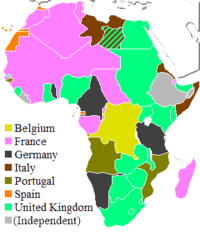
Areas of Africa under the control or influence of European nations in 1914 (at outbreak of
World War I).
In the late nineteenth century, the European powers occupied much of the continent, creating many
colonial and dependent territories. They left only two fully independent states:
Ethiopia (known to Europeans as "Abyssinia"), and
Liberia.
Egypt and
Sudan were never formally incorporated into any European colonial empire. However, after the British occupation of 1882, Egypt was effectively under British administration until 1922.
The
African Union (AU) is a 53 member federation consisting of all of Africa's states except
Morocco.
The African Union, not to be confused with the AU Commission, aims to transform the
African Economic Community, a federated commonwealth, into a state under established international conventions.
The African Union has a parliamentary government, known as the
African Union Government, consisting of legislative, judicial and executive organs. It is led by the African Union President and Head of State, who is also the President of the
Pan African Parliament. A person becomes AU President by being elected to the PAP, and subsequently gaining majority support in the PAP.
A civil war in the
Democratic Republic of the Congo (formerly
Zaire) began in 1998. Neighbouring African countries have become involved. Since the conflict began, the estimated death toll has reached 5 million.
Political associations such as the
African Union offer hope for greater co-operation and peace between the continent's many countries. Extensive human rights abuses still occur in several parts of Africa, often under the oversight of the state.
RELIGION
Voodoo Flag
Most traditional African religions professed continent, inaccurate encompassed within the group known as animist. This means they believe that spirits inhabit animate or inanimate objects. Such so it tends to persist under the guise of universalist religions like Islam or Christianity. Rastafarians are also believers.
Islam has a dominant presence in the north and prominent in the Sahara, the Sahel, West Africa and East Africa. Monophysite Christianity, although older than Islam, was confined to Ethiopia. From the twentieth century take on a growing importance Catholicism and Protestantism.
However, both Islam and Christianity in Africa are more or less sectarizados syncretism as Kimbanguism or the Church "Rendezvous with Life", which persist and reproduce thanks to strong implicit concepts of traditional religions. Traditional African religions have a presence in America, especially the voodoo in Haiti, the Yoruba religion and the religions of the ancient kingdom of Congo in the Caribbean and Brazil mainly.
There are also minority Hindus.
symbolism
Simbolismo
These are the countries of Africa:
North Africa[change]
East Africa[change]
West Africa[change]
Central Africa[change]
South Africa[change]
African diaspora[change]
Countries with significant African descendents outside Africa:
Africa has a lot of wildlife.
[13][14] There are many types of animals there. In particular, it is now the only continent that has many native species of large
mammals. Some of them occur in very large numbers. There are
antelope,
buffalo,
zebra,
cheetah,
elephant,
lion,
giraffe,
rhinoceros,
apes,
hyaena, and a lot more. Over 2,000 types of
fish live in African
lakes and
rivers.

PEOPLE

taken:
 nts
nts 


